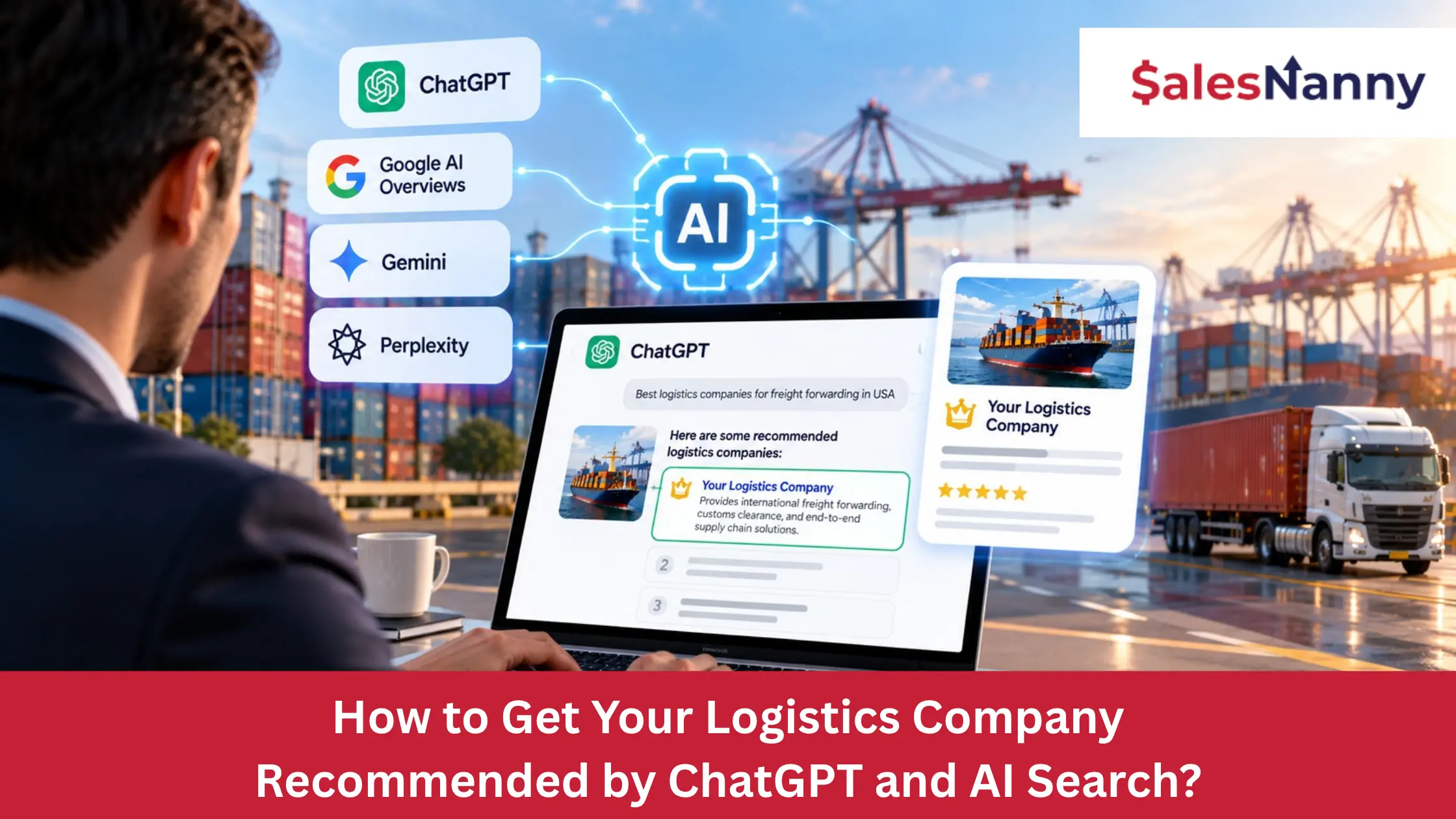
A shipper looking for a new logistics provider may not always start with Google anymore. They might ask ChatGPT, “Which freight forwarder can handle pharmaceutical air freight from the U.S. to Europe?” or ask Gemini, “Which 3PLs provide food-grade warehousing near Atlanta?”
Within seconds, they may get a shortlist of companies to explore. If your competitor appears and your logistics company does not, that buyer may never visit your website, review your capabilities, or contact your sales team.
This is why AI search visibility is becoming more important for freight forwarders, 3PLs, transport companies, and other logistics businesses. Buyers are asking more detailed questions about services, locations, cargo types, trade lanes, certifications, and industry experience before they ever speak with a provider.
There is no guaranteed way to get recommended by ChatGPT, Gemini, or another AI search platform. But you can make your logistics company easier to find, understand, and verify when a buyer asks a question that matches what you do.
In this blog, we will look at the practical steps logistics companies can take to improve visibility in ChatGPT and AI search.
How does AI Search Understand Your Logistics Company?
AI search needs clear information about what your logistics company does, where you operate, and the type of customers you serve.
If your homepage only says something like “Your trusted global logistics partner,” it does not clearly explain whether you handle temperature-controlled air freight, cross-border trucking, project cargo, customs brokerage, warehousing, or e-commerce fulfillment.
Compare that with a more specific statement such as: “We provide temperature-controlled air freight for pharmaceutical shippers moving cargo between the U.S. and Europe.”
Now the service, industry, and market are much clearer.
That level of detail helps buyers understand whether you fit their requirement and gives search platforms more context when they are answering specific logistics questions.
1. Build Clear Pages for the Logistics Services You Want to Sell
Do not rely on one general services page to explain everything your business handles.
If you want enquiries for ocean freight, air freight, customs brokerage, warehousing, project cargo, or last-mile delivery, each of those services should have a clear page explaining who the service is for, what you handle, where you operate, and what makes your capability relevant.
You can also go deeper where it makes commercial sense. For example, “Ocean Freight Services” is broad, while “Ocean Freight From China to the U.S. for Retail Importers” gives much more context.
If your strength is a particular trade lane, cargo type, industry, or location, make that information easy to find on your website. This helps both the shipper and the search platform understand where your company fits.
2. Create Content Around the Questions Your Shippers Actually Ask
Your buyers do not always search with short keywords. They may ask detailed questions based on a real freight requirement.
A shipper might ask, “How long does air freight from the U.S. to Germany take?”, “How do you handle temperature-sensitive pharma cargo?”, or “What happens if a container misses a cutoff?”
Those are the types of questions your content should answer.
Instead of creating another broad article because a keyword has search volume, build content around the real decisions your buyers are trying to make. This gives you a better chance of attracting relevant traffic and also makes your content Your more useful when AI search platforms are looking for an answer.
Your keyword strategy can still include terms such as AI search for logistics companies, AI search visibility for freight forwarders, and logistics company recommended by ChatGPT, but the page itself should speak naturally to the buyer’s problem.
3. Show Real Proof of Logistics Experience
A shipper will not choose your company just because your website says you are reliable.
You need to show what you have actually handled.
If you want more project cargo enquiries, publish a case study that explains what was moved, the origin and destination, cargo dimensions or weight, route challenges, permits, special handling requirements, and how the shipment was completed.
If you want more pharmaceutical customers, show your experience with temperature-sensitive cargo, compliance requirements, trade lanes, shipment monitoring, or any relevant operational challenges you have managed.
Specific logistics examples make your experience easier for buyers to evaluate and give search platforms stronger information about the type of work your company is known for.
4. Keep Your Business Information Consistent Across the Web
Your website may say you are an international freight forwarder, while your LinkedIn page describes the company differently and an old directory still shows services or locations you no longer offer.
That inconsistency can make your business harder to understand.
Review your website, LinkedIn company page, Google Business Profile, logistics directories, association listings, partner pages, and industry publications. Your company name, locations, core services, and positioning should be accurate and consistent.
Third-party mentions can also help support what your website says. If logistics publications, associations, technology partners, directories, or customer stories also connect your company with a particular service or industry, there is more supporting information available when a buyer researches you.
5. Make Sure ChatGPT and Google can Access Your Website
Strong logistics content will not help much if search platforms cannot crawl or index it properly.
Your important service pages, industry pages, case studies, and blogs should be indexable, internally linked, and easy to access. For ChatGPT Search, your website should also allow OAI-SearchBot if you want your public content to be eligible for discovery.
Traditional SEO still matters here. A strong SEO and organic marketing strategy supports both normal search visibility and AI-led discovery by making your website easier to crawl, understand, and connect with relevant buyer questions.
So rather than treating AI search as a completely separate marketing activity, build it on top of a strong SEO foundation.
6. Check Whether Your Logistics Company is Actually Being Recommended
Do not assume your company is appearing in AI search just because your website ranks well in Google.
Test the types of questions your real customers might ask. For example, you could search:
“Recommend freight forwarders handling pharma cargo in the U.S.”
“Which 3PLs support e-commerce fulfillment in Texas?”
“Who handles oversized project cargo in the U.S.?”
Then look at which companies are mentioned, what reasons are given for recommending them, which sources are cited, and whether your own company information is accurate.
This can also show you where competitors have stronger content or clearer proof than you do. Over time, you can track referral traffic from ChatGPT, branded searches, enquiry sources, and leads that mention AI search.
What should Logistics Companies Avoid?
The biggest mistake is trying to optimize for AI search while leaving the main website weak.
If your services are vague, your location information is outdated, your content does not answer real buyer questions, or your website has only one general services page, AI search optimization will not fix the underlying problem.
Your first priority should be to make it easy for a shipper to understand exactly what you do, who you serve, where you operate, and why your experience is relevant.
Once that foundation is clear, AI search visibility becomes much easier to build on.
How can SalesNanny Help Your Logistics Company Improve AI Search Visibility?
SalesNanny has 10+ years of logistics marketing experience, has supported 80+ accounts, and has helped generate 100K+ inbound leads.
Because we work with freight forwarders, 3PLs, transport companies, and other logistics businesses, we start with the services you want to grow, the industries and trade lanes you want to target, and the questions your buyers are likely to ask.
For logistics businesses looking for the best digital marketing agency to improve search visibility, SalesNanny can connect technical SEO, service and industry pages, buyer-focused content, off-page visibility, and conversion improvements across both traditional and AI-led search.
This helps make your company easier to find when the right shipper is actively researching a logistics provider like you.
Conclusion
The way logistics buyers search is changing.
Some will still use Google. Others will ask ChatGPT, Gemini, or another AI search platform to help compare providers and build a shortlist.
Your company needs to clearly show what freight you handle, where you operate, which industries you serve, and what proof supports those claims.
The question is no longer only, “Are we ranking on Google?” It is also, “When our ideal shipper asks AI for a logistics provider like us, does our company have enough relevant information to be considered?”
Book a Free Consultation with SalesNanny to discuss your SEO and AI search visibility strategy.