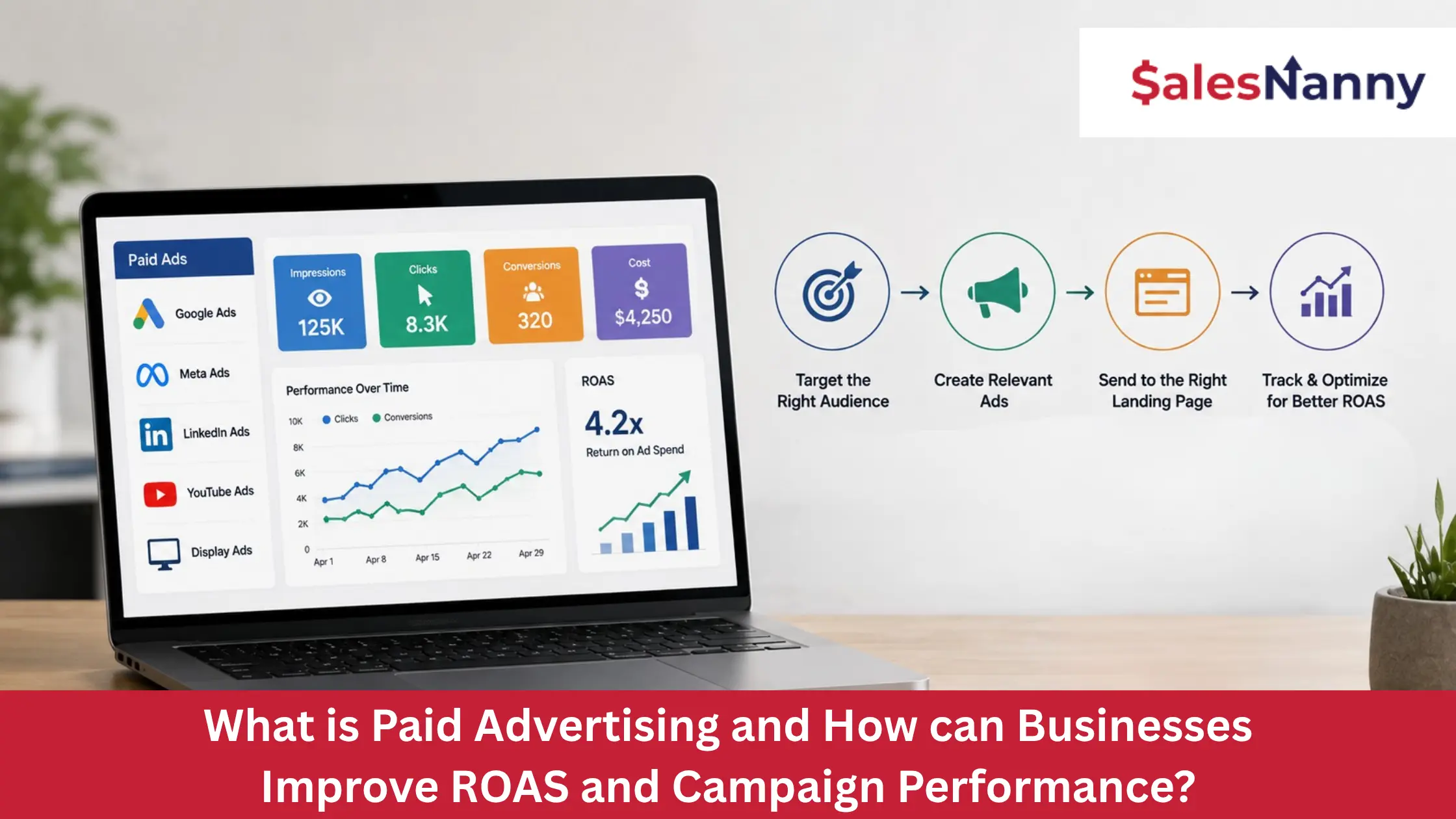
Paid advertising can bring traffic quickly. But more clicks do not always mean better business results.
A campaign may look busy with impressions, clicks, and form submissions while still producing expensive or poor-quality leads.
That is why businesses need to look beyond traffic. They need to understand how much they are spending, what they are getting back, and which campaigns are creating real sales opportunities.
What is Paid Advertising?
Paid advertising is a way for businesses to pay to show ads to a specific audience.
These ads can appear on Google Search, social media platforms, websites, videos, and other digital channels.
Common types include search ads, social media ads, display ads, video ads, and remarketing ads.
One of the primary advantages is speed. Businesses do not have to wait months to increase their visibility. Ads can start reaching potential customers shortly after a campaign is launched.
But paying for visibility does not guarantee results.
The campaign still needs the right audience, message, offer, landing page, and tracking.
Why is Paid Advertising Important for Businesses?
Paid advertising gives businesses more control over who they target.
For example, a company can target individuals based on their search terms, location, interests, job roles, or previous website visits.
It can be useful for businesses that want to:
- Generate leads
- Promote an important service.
- Enter a new market.
- Test a new offer.
- Reach buyers with strong purchase intent.
Paid advertising also gives businesses clear performance data.
A 2025 LocaliQ study of over 16,000 search advertising campaigns across 23 industries found an average 6.66% click-through rate, $5.26 cost per click, 7.52% conversion rate, and $70.11 cost per lead.
These numbers should not be treated as targets for every business. Costs can change based on competition, industry, location, audience, and offer.
They do show why businesses need to measure what happens after someone clicks an ad.
What is ROAS and How is it Different from ROI?
ROAS stands for Return on Ad Spend.
It shows how much conversion value or revenue a company generates in comparison to how much it spends on advertising.
ROAS = Conversion Value ÷ Ad Spend
For example, if a company spends $5,000 on ads and tracks $20,000 in revenue from those campaigns, its ROAS is:
$20,000 ÷ $5,000 = 4x ROAS
That means the campaign generated $4 in estimated profits for every $1 spent on advertising.
ROI is slightly different.
ROI takes a broader perspective on profit versus cost. ROAS is mostly concerned with advertising spending and the value assigned to it.
A high ROAS does not always imply a substantial profit. Margin, sales costs, operating costs, and customer value all have an impact on the overall return.
How do businesses calculate and monitor ROAS?
ROAS is simple to calculate. Getting accurate data for that calculation can be difficult.
Businesses must first decide which conversions are most important.
For an online retailer, that could be a completed transaction.
A qualified inquiry, scheduled consultation, sales opportunity, or closed customer could all refer to a B2B or service business.
Google Ads allows businesses to assign different conversion values. This helps them understand business value rather than treating all conversions equally.
For example, imagine two campaigns each generate 20 leads.
Campaign A: $2,000 spend → $12,000 conversion value
Campaign B: $2,000 spend → $5,000 conversion value
Both produced the same number of leads.
But Campaign A delivered a 6x ROAS, while Campaign B delivered 2.5x.
That is why businesses should monitor ROAS along with cost per lead, conversion rate, lead quality, customer acquisition cost, and actual sales.
Why do Paid Advertising Campaigns Deliver Poor ROAS?
Poor ROAS does not always indicate a small advertising budget.
Sometimes the budget is allocated in the wrong places.
Common issues include targeting large audiences, bidding on low-intent keywords, paying for irrelevant searches, using weak ad messages, and sending visitors to subpar landing pages.
Tracking can also produce an inaccurate picture.
If a campaign generates 50 form submissions but only five are relevant to the sales team, counting all 50 as equal conversions can make performance look better than it really is.
Before spending more money, businesses should identify where their campaigns are losing value.
How can businesses improve their ROAS and campaign performance?
1. Improve Audience and Keyword Targeting
Reach out to people who are more likely to need your product or service.
Review your search terms, audiences, locations, and other targeting options on a regular basis. Remove costly traffic that rarely generates useful leads.
2. Send Visitors to Relevant Landing Pages
The landing page should match the ad’s promise.
Keep the message simple, explain the offer clearly, provide relevant proof, and make the next step easy.
3. Reduce Wasted Ad Spending
Do not continue to allocate budget to campaigns simply because they generate clicks.
Review poor-performing keywords, ads, audiences, devices, locations, and placements. Move more budget toward the areas producing better results.
4. Track Sales Value, Not Just Conversions
Form submission is just the beginning.
Wherever possible, link advertising data to qualified leads, sales opportunities, customers, and revenues.
This provides a much clearer picture of which campaigns need more money.
How can Paid Advertising Generate a More Consistent Flow of Qualified Leads?
Consistent lead generation does not come from increasing the budget every time performance declines. It comes from understanding what already works.
Businesses that know which keywords, audiences, ads, landing pages, and offers attract the right customers can make better budget decisions.
A focused paid ads marketing strategy should connect campaign performance with lead quality and sales results.
Businesses seeking the best digital marketing agency should look beyond campaign setup. The right partner should be knowledgeable about targeting, landing pages, conversion tracking, lead quality, and how paid ads can help with real-world sales.
The goal isn’t simply to generate more leads. It is to generate more of the right leads at a price that the business can afford.
Conclusion
Paid advertising can help businesses reach potential customers quickly, but clicks do not indicate whether a campaign is successful.
Businesses must consider ROAS, conversion value, cost per lead, lead quality, and sales results together.
Better targeting, stronger landing pages, more accurate tracking, and wiser budget decisions can all help improve campaign performance before more money is spent.
If your paid campaigns are getting traffic but not enough qualified leads or returns, Book a Free Consultation with SalesNanny to identify where your paid advertising performance can improve.