Almost every logistics business uses Google Business Profile to help customers find them. But how much can you actually understand from the performance data?
You may know how many people viewed your profile or clicked through to your website. But if you want to understand who is finding you, what they are searching for, how they are engaging, and whether that activity is changing over time, the analysis can take more effort.
Google is now testing a new Business Profile performance report that brings more of this information together. The test introduces sections for engagement, reviews, search trends, audience, and recommendations.
Let’s look at what Google is testing and what businesses could expect from the new report.
What is Google Testing?
Google is testing a redesigned Performance section inside Business Profiles.
The new view brings several areas of Business Profile activity together, including:
- Overview
- Engagement
- Reviews
- Search trends
- Audience
- Recommendations
The idea is simple: instead of looking at Business Profile activity as just a collection of numbers, businesses could get a clearer view of how people are finding and interacting with them.
Here’s an example of the new Performance view:
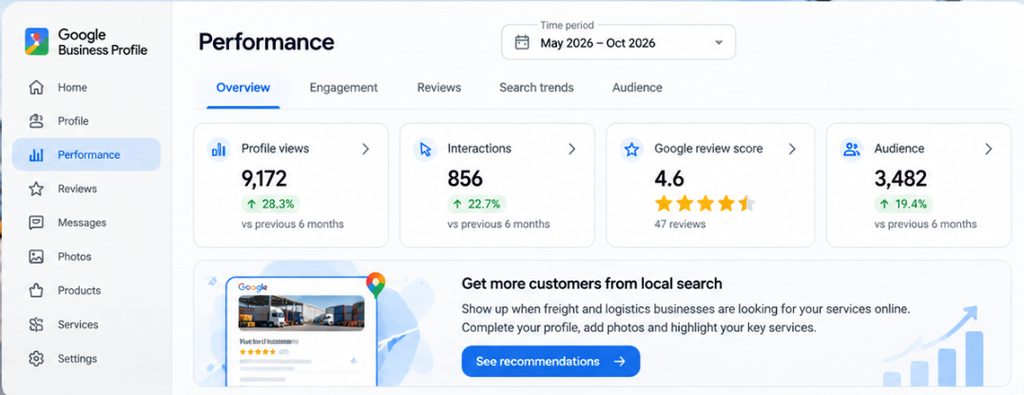
The screenshot shows the new Performance area with sections such as Engagement and Reviews, along with recommendations and a time-period selector.
This gives a business owner a quick starting point before going deeper into individual areas.
A Closer Look at the Engagement Data
The Engagement section is where the update becomes particularly useful.
In the test, businesses can see different types of interactions rather than treating all profile activity as one number.
For example, the report can separate interactions such as:
- Calls
- Chat clicks
- Bookings
- Website clicks
- Other profile interactions
Here’s what the detailed Engagement view looks like:
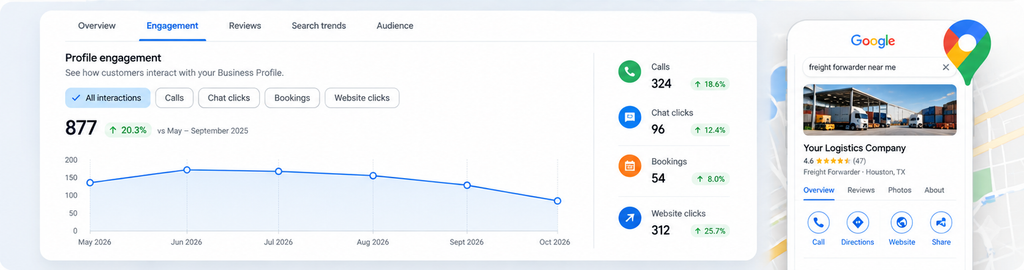
The screenshot shows an overall interaction figure along with a trend line across different months. Businesses can also switch between different interaction types to understand how customers are responding to the profile.
This gives a much clearer picture than simply knowing that people viewed the Business Profile.
For example, if profile views are increasing but website clicks and calls are falling, that tells a very different story from simply saying, “Our Google visibility is growing.”
What Else could Businesses Learn from the New Report?
The test also includes areas for Reviews, Search Trends, and Audience.
That means businesses could potentially look at different parts of their Google presence from the same Performance area.
Search Trends can help businesses understand how search activity around their profile is changing.
Reviews can give more visibility into customer feedback.
The audience can provide information about the people reaching the profile.
And the Recommendations section can surface actions or areas that Google thinks may need attention.
The important point is that Google appears to be moving toward a more complete view of Business Profile performance rather than focusing only on basic visibility numbers.
Why does this Matter for Logistics Businesses?
This is where the update becomes relevant to logistics companies.
Think about a freight forwarder serving Houston.
A shipper may search for a freight forwarding company, find the business on Google, check its reviews, visit the website, and then call for a quote.
For the logistics company, simply knowing that the Business Profile received views does not tell the whole story.
The more useful questions are:
Are the right people finding us?
What are they doing after they find us?
Are they visiting our website or calling the team?
Which searches are bringing them to us?
The new reporting experience could make it easier to answer some of these questions from the Business Profile itself.
Why is this More than Just a Reporting Update?
For a logistics business, local visibility is only useful when it helps create business opportunities.
A trucking company could receive plenty of profile views but very few calls. A warehouse could have strong local visibility but weak website clicks. A freight forwarder could see growing search activity but find that the searches are not related to its target services.
These are the kinds of differences that matter when you are deciding where to improve your marketing.
So the bigger value of better reporting is not simply having more data.
It is being able to connect:
Search visibility → Customer interaction → Website visit or enquiry → Business opportunity
That gives marketing teams a better starting point for deciding what needs attention.
What should Logistics Businesses do Now?
There is no need to change your local SEO strategy just because Google is testing this report.
The feature is still being tested, so the final version could change before Google makes it available more widely.
For now, logistics businesses can continue using their existing Business Profile data and make sure the basics are in place:
- Keep services and business information accurate.
- Keep your service areas updated.
- Monitor customer reviews.
- Check which searches are bringing visibility.
- Make sure your website clearly explains your services.
- Make it easy for potential customers to contact you.
If the new reporting experience becomes widely available, these areas will give you a stronger foundation for using the additional insights.
What could this Mean for Logistics Marketing?
The direction of this update is worth watching.
Google is testing a reporting experience that looks beyond simple profile visibility and brings together engagement, reviews, search trends, audience information, and recommendations.
For logistics businesses, that could make it easier to understand not only whether people are finding you, but also what they do after they find you.
And that is the part that matters.
A profile view is not the end goal. The goal is to get the right shipper, importer, exporter, or business customer to take the next step.
Final Thoughts
Google’s new Business Profile Performance report is still a test, so there is no need to treat it as a major change yet.
But if Google rolls it out more widely, businesses could have a more useful way to understand their local search performance, from how people discover them to how they engage with the profile.
For logistics companies, this can help connect local SEO with something much more important: generating real customer enquiries.
Whether you manage your marketing internally or work with the best digital marketing agency, the goal should always be the same: use search data to understand what customers want and turn that visibility into business opportunities.